How to tell if a ring is real solid gold in 10 seconds

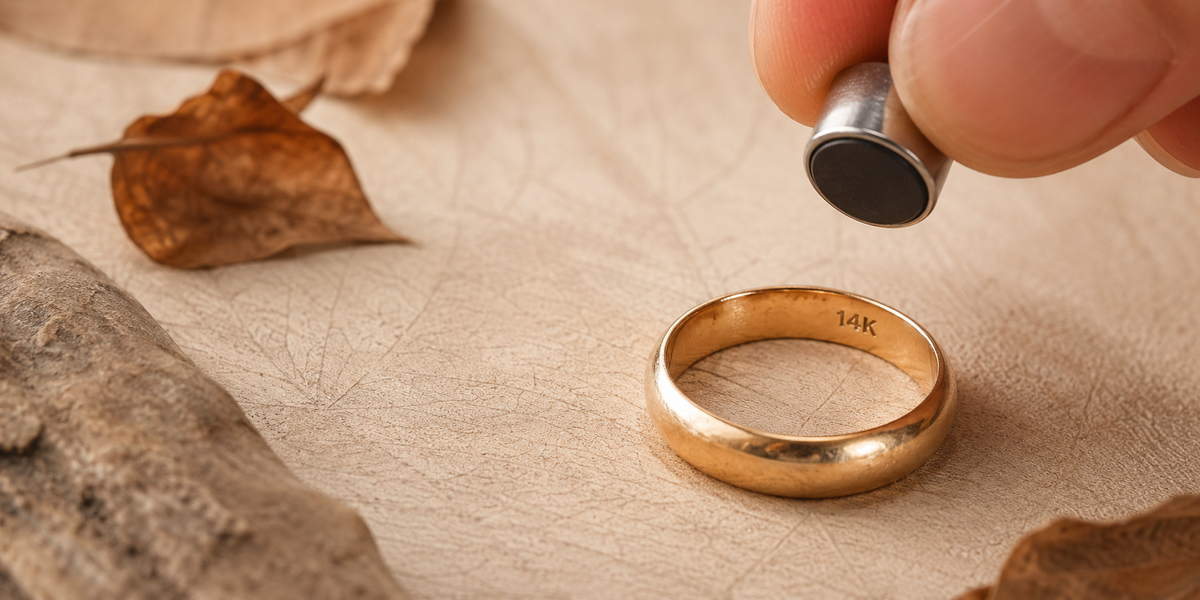
Look for a hallmark stamp first, that's the fastest single check. Then try the magnet test, real gold never sticks. Neither one alone proves anything for certain, but together they'll tell you in under a minute whether a ring is worth taking seriously or worth walking away from.
Here are the checks, fastest first.
1. Look for the hallmark stamp
Almost every real gold piece is stamped somewhere on the inside of the band. Look for a number like 417, 585, or 750, or a karat mark like 10K, 14K, or 18K. This is the fastest check there is, if you can see the ring up close, this takes about three seconds.
No stamp at all is a red flag, though not automatic proof of fakery, some handmade or vintage pieces skip it. But a legitimate seller stamping their gold is a basic sign of a business that has nothing to hide.
2. Do the magnet test
Gold is not magnetic. At all. If a ring sticks to a strong magnet, even slightly, it's not solid gold, full stop. This test can't confirm real gold on its own since plenty of non-magnetic metals also aren't gold, but it can instantly rule a fake one out.
You need an actual strong magnet for this, not a fridge magnet, those are usually too weak to show a real reaction either way. A small neodymium magnet works best and costs next to nothing.
3. Check the weight
Gold is dense, noticeably heavier than most metals used to fake it. Hold the ring in your palm. A ring that feels suspiciously light for its size, especially a larger or chunkier design, is worth a second look.
This one takes practice to trust, since "feels light" is subjective if you don't have anything to compare it to. It's a supporting signal, not a standalone test.
4. Watch for skin discoloration, but read it carefully
This one's less clear-cut than people assume, so it's worth explaining properly.
Gold-plated jewelry over base metal often leaves a green or black tint on the skin, especially after sweat or water exposure, once the thin gold layer wears through to the metal underneath. That much is true.
But solid gold isn't automatically immune to this either. 10K and 14K gold are mixed with real percentages of other metals, usually copper and silver, to make the alloy strong enough for everyday wear. Those alloy metals can react with sweat, skin pH, lotion, or chlorine and cause mild discoloration on some people, even with completely genuine solid gold. It's more common in lower karat gold and less common in 18K, since 18K has a higher percentage of pure gold and less alloy to react. Some people also have a nickel allergy, which shows up as skin irritation or discoloration if a ring's alloy contains nickel, this is a personal skin reaction, not a sign the gold itself is fake.
So the distinction isn't "any discoloration means it's fake." The distinction is in how it behaves over time. Mild, occasional discoloration that washes off and doesn't return, or only shows up after specific triggers like chlorine or certain lotions, is normal for lower karat solid gold. Discoloration that keeps getting worse, spreads, or eventually reveals a different colored metal showing through the band, that's plating wearing off, not an alloy reaction.
If you're not sure which one you're seeing, that's exactly the situation to bring to a jeweler for a quick check rather than guessing.
5. When none of this is conclusive, get it verified
These checks are genuinely useful, but none of them are lab-accurate. The only fully certain way to confirm gold content is an acid test or electronic gold tester, done by a jeweler or pawnshop. This takes a few minutes, most jewelers will do it for free or close to it, and it's worth doing before any major purchase or resale, especially secondhand.
One thing worth knowing: this works differently depending on how the ring is being sold. For a ready-made piece already sitting on a shelf, you can usually get it checked before paying anything at all. For a custom, made-to-order piece, that's not how it works, most jewelers, ourselves included, require a deposit upfront before production even starts, since the gold and labor cost real money regardless of the outcome. In that case, verification happens on the finished piece before the remaining balance and shipping, not before any money changes hands. Ask upfront how your specific jeweler handles this so there's no confusion later.
Frequently asked questions
Does the water float test actually work? Not reliably, despite how often it gets shared online. Gold is dense enough to sink, but so are several other metals, so a ring sinking in water doesn't confirm anything on its own. Skip this one, it gives false confidence.
Can plated gold pass the magnet test? Usually yes, if the base metal underneath is also non-magnetic (like brass or copper), a plated ring won't stick to a magnet either. This is exactly why the magnet test only rules things out, it doesn't prove a ring is real on its own.
What do the numbers 417, 585, and 750 mean? They're the metric purity stamps for 10K, 14K, and 18K gold. 750 means 75% pure gold, which is 18K. 585 is roughly 58.5%, or 14K. 417 is about 41.7%, or 10K.
Is a stamped ring always genuinely solid gold? No, stamps can be faked, though it's uncommon in casual buying situations. A stamp is a strong first signal, not absolute proof, which is why a jeweler check matters for anything expensive.
None of these tests replace an actual jeweler's verification, but together they'll tell you fast whether something's worth getting checked properly, or worth returning before you're stuck with it.
Tags: buying guide, solid gold, jewelry tips