Why we recommend lab-created gems for every vanya piece

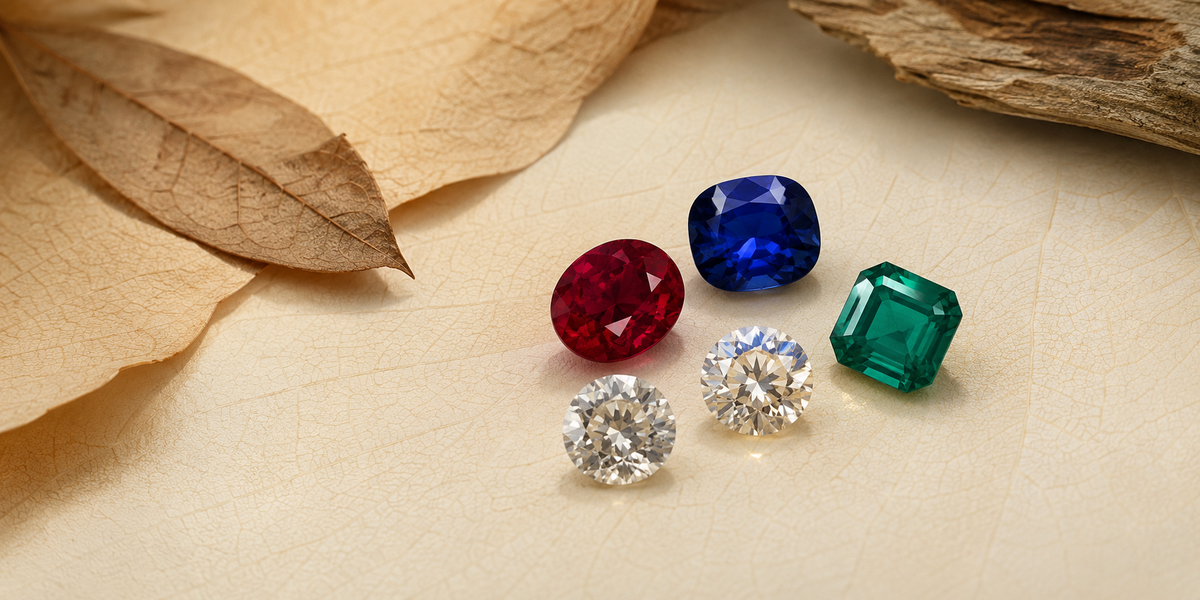
On average, mining a single one-carat diamond means moving roughly 200 to 250 tons of earth. Colored gemstone mining carries its own real environmental footprint too, land disturbance, water use, and habitat disruption, depending on the stone and the region. That's why we recommend lab-created stones, diamonds, sapphires, rubies, emeralds, and moissanite, as the default for every vanya piece. We're not closing the door on natural stones entirely, we've fulfilled orders with them before, and we're always happy to set a stone a customer already owns, but if you ask us what we'd choose, it's lab-created, every time.
The number that's hard to unsee
Once you know the 200-to-250-ton figure for diamond, a widely cited industry average for how much rock and ore gets excavated per carat of rough diamond recovered, it's genuinely difficult to look at a mined stone the same way again. A lab-created stone of the exact same size and quality requires none of that displacement.
Lab-created gems aren't new, and that surprises people
Lab-grown diamonds get most of the attention right now, but lab-created colored gemstones have actually been around far longer. Chemist Auguste Verneuil developed the flame fusion process for creating gem-quality rubies in 1902, and the same basic technique has been used to grow sapphires ever since, well over a century of real, established science, not a recent trend. Lab-created emeralds use a different method, hydrothermal synthesis, essentially growing the crystal in a heated, pressurized water solution, and have their own long track record too.
This matters because it undercuts the idea that lab-created stones are some kind of shortcut or recent workaround. The technology predates lab-grown diamonds by decades.
Chemically identical, meaningfully different in origin
Worth being precise about this, since it's easy to get wrong: a lab-created sapphire is corundum, the exact same mineral as a natural sapphire. A lab-created ruby is also corundum, colored by the same trace element, chromium, that colors a natural one. A lab-created emerald is beryl, same as a natural emerald. None of these are simulants standing in for the real thing, they are the real mineral, grown under controlled conditions instead of found underground. A gemologist needs specialized equipment to tell a lab-created stone apart from its mined counterpart.
Moissanite sits in a different category worth naming clearly: it's not a lab-created version of an existing natural gem, it's its own distinct mineral, silicon carbide, which is only naturally found in trace amounts and is otherwise entirely lab-produced for jewelry use. It's real, it's just not standing in for anything.
Why this matters for a brand built the way we are
Every vanya ring already funds a tree through our reforestation partnership. That commitment is a lot easier to stand behind when the stone itself didn't require significant land disturbance to source, whether that's a diamond or a colored gemstone. Recommending lab-created stones across the board isn't about closing doors, it's about defaulting to the choice that actually matches the rest of what we do, while still leaving room for the real, individual reasons someone might want something else.
We're not here to tell you natural stones are wrong
This is worth saying plainly. Plenty of people choose natural diamonds and gemstones for reasons that matter to them, family tradition, personal meaning, the idea of something formed over geologic time. Those are real, valid reasons, and we're not interested in shaming anyone's choice.
What we're saying is narrower and more honest: once we understood the actual environmental footprint of mining, across diamonds and colored gemstones alike, we couldn't build an eco-conscious brand around stones that worked against everything else we were doing. That's a decision about our own sourcing, not a verdict on anyone else's ring.
What this actually means for you as a buyer
No compromise on how the stone looks or performs, a well-cut lab-created diamond, sapphire, ruby, or emerald is genuinely beautiful under normal light, full stop. What you get on top of that: a lower price than a comparable mined stone in most cases, and material that didn't require significant land disturbance to reach you.
Frequently asked questions
Is a lab-created gemstone a "fake" stone? No. A lab-created sapphire, ruby, or emerald is the same mineral as its natural counterpart, same chemical structure, same hardness, same optical properties. "Lab-created" describes where it was grown, not whether it's real.
How long have lab-created gemstones existed? Lab-created rubies and sapphires date back to 1902, using the Verneuil flame fusion process, over 120 years of established technique, well before lab-grown diamonds became commercially available.
Is moissanite the same thing as a lab-created diamond? No. Moissanite is its own distinct mineral, silicon carbide, not a lab-grown version of a diamond or any other natural gem. It's real and lab-produced, just not standing in for something else.
Does vanya ever work with natural stones? Yes, on occasion. It's not our default or our recommendation, but we've fulfilled orders with natural stones before, and we're glad to set a stone a customer already owns, an heirloom piece, a family stone, something with its own personal history. If you ask what we'd choose given a free choice, it's lab-created, every time, but that's a recommendation, not a rule we won't bend on.